
The questions Autoprop and Varifold owners ask me most. Can’t see yours? Email me at roderick@kingpropulsion.com, with your serial number if you have it, and I’ll answer it.
Every year at haul-out: clean it, grease all three blades and fit a new anode. That’s twenty minutes on the hard and the cheapest insurance on the boat. The bearings last about 1,000 engine hours on average; replace them then, or sooner if the blades show play, feel rough as you turn them, or the prop starts to rumble under power. If you’re not sure, send me a photo and your serial number and I’ll tell you whether it needs a kit, a rebuild or just a bit of grease.
Three things decide it: the hub size (H5, H6, H9 or H20), the bearing type (ball or roller) and, on roller-bearing props, how the bearing is locked (tab washer or tab screw). The kit name spells all three out: APP-H6-BK-TS, for example, is an H6 roller-bearing kit with tab screws. You don’t have to work any of that out. Send me your serial number and I’ll tell you the exact kit. Kits are sold complete, never split. Or type your serial into Find my kit and see the parts for your propeller.
On an Autoprop, the AP number is stamped on the side of a blade, near the grease port. The letters after the number (LH or RH) give the hand of the propeller. On a Varifold, the VF number is stamped on the root of a blade: the part that rests on the hub when the blade is open. Fold the blade closed and it’s easy to read. A soft brush and a good light help if it’s under antifouling, or a season’s worth of barnacles. Can’t find it? The original invoice often has it, or a few photos of the hub and blades plus the boat and engine usually let me identify it. Either way, write it down somewhere drier than the propeller.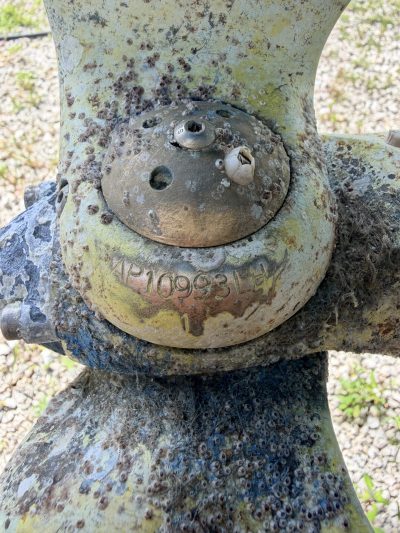
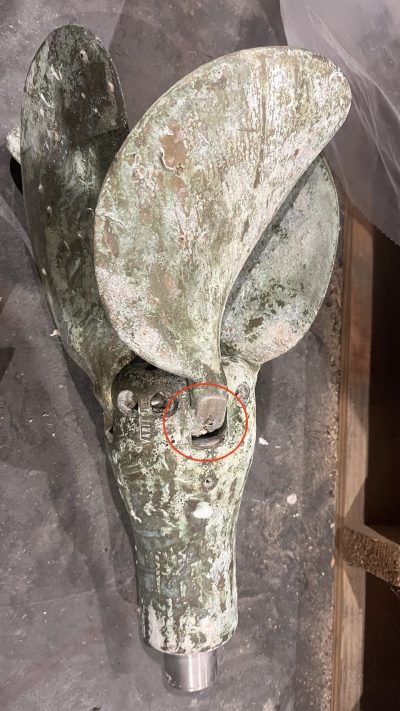
Left: Autoprop serial beside the grease port. Right: Varifold serial on the blade root (circled).
They’re the hub families. For Autoprop, the number grows with the propeller: roughly, H5 suits boats up to 30 feet, H6 up to 60 feet and H9 up to 90 feet. H20 is the two-blade Autoprop. Varifold hubs are named by their diameter in millimeters: VF70 (two-blade, 70 mm), VF108 (three-blade, 108 mm), VF120 (larger three-blade, 120 mm) and VF160 (four-blade, 160 mm). Your serial number tells me which one you have, so there’s no need to measure anything.
Yes, if you’re handy with tools. Bruntons supply step-by-step instructions with each bearing kit, and the job needs the Autoprop peg spanner, lock screw spanner and nut spanner, a torque wrench and thread locker. Take the prop off the shaft and work on it in a vise: it’s cleaner and faster. If you’d rather not, send it to me and I’ll rebuild it for you.
For every Autoprop, a waterproof, corrosion-resistant bearing grease: SKF LGWA 2 or a similar lithium complex grease. Pump it in until fresh grease pushes the old out, then refit the screws. Ordinary general-purpose grease washes out, and the bearings notice before you do. Varifold owners can skip this one: a Varifold is water-lubricated and needs no grease at all.
I don’t sell anodes on their own; BoatZincs stock them and ship quickly. Fit a new one every haul-out, or sooner once it’s half gone. Keep the mating face clean and bare so it makes good contact, and never paint it: a painted anode is just decoration.
Look after it once a year and it will look after you. At every haul-out, grease all three blades and fit a new anode. Then turn each blade by hand: it should rotate smoothly, with a light resistance from the seals, and no knock or wobble. Replace the bearings at about 1,000 engine hours, before wear has a chance to show. If anything feels different from last season, email me a photo and your serial number before you launch.
Possibly, but let’s measure before we machine anything. Run a sea trial and fill in the King Propulsion Sea Trial Sheet. I’ll plot your speed and rpm against your engine’s demand curve and run it past Bruntons’ software, free. If the pitch needs to go up or down, the re-pitch and balance is done at the factory and quoted at that point.
